- English
- French
- German
- Portuguese
- Spanish
- Russian
- Japanese
- Korean
- Arabic
- Irish
- Greek
- Turkish
- Italian
- Danish
- Romanian
- Indonesian
- Czech
- Afrikaans
- Swedish
- Polish
- Basque
- Catalan
- Esperanto
- Hindi
- Lao
- Albanian
- Amharic
- Armenian
- Azerbaijani
- Belarusian
- Bengali
- Bosnian
- Bulgarian
- Cebuano
- Chichewa
- Corsican
- Croatian
- Dutch
- Estonian
- Filipino
- Finnish
- Frisian
- Galician
- Georgian
- Gujarati
- Haitian
- Hausa
- Hawaiian
- Hebrew
- Hmong
- Hungarian
- Icelandic
- Igbo
- Javanese
- Kannada
- Kazakh
- Khmer
- Kurdish
- Kyrgyz
- Latin
- Latvian
- Lithuanian
- Luxembou..
- Macedonian
- Malagasy
- Malay
- Malayalam
- Maltese
- Maori
- Marathi
- Mongolian
- Burmese
- Nepali
- Norwegian
- Pashto
- Persian
- Punjabi
- Serbian
- Sesotho
- Sinhala
- Slovak
- Slovenian
- Somali
- Samoan
- Scots Gaelic
- Shona
- Sindhi
- Sundanese
- Swahili
- Tajik
- Tamil
- Telugu
- Thai
- Ukrainian
- Urdu
- Uzbek
- Vietnamese
- Welsh
- Xhosa
- Yiddish
- Yoruba
- Zulu
Apple cider vinegar fruit powder and liquid ACV are both derived from fermented apple (Pyrus malus) juice, yet they serve very different roles in B2B formulation. If your operation requires shelf stability, precise dosing, and clean-label compatibility, apple cider vinegar fruit powder is the stronger choice. Liquid ACV suits traditional culinary or simple supplement applications, but its high water content, acidity-related logistics, and batch variability create real challenges for manufacturers. This article breaks down both formats across technical, nutritional, and procurement dimensions to help you decide what fits your product line.
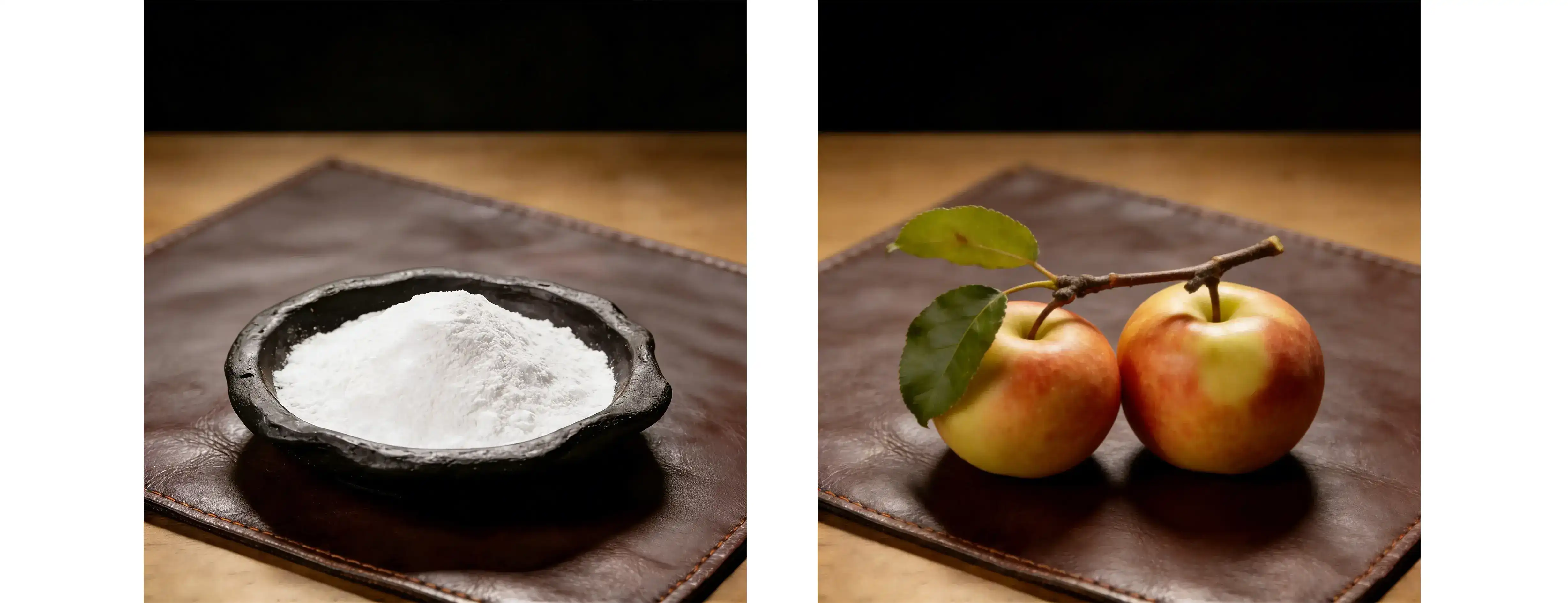
Understanding Apple Cider Vinegar Fruit Powder and Liquid
To be able to compare the two, you should know how they are made and what they are made of.
What Is Apple Cider Vinegar Fruit Powder?
Spray-drying fermented apple cider vinegar broth onto a carrier matrix like maltodextrin or resistant dextrin produces apple cider vinegar fruit powder (Pyrus malus, fruit). This method packs in a lot of acetic acid, malic acid, and a few enzymes, leaving behind the water phase. After being mixed with water, it turns into a brownish-yellow powder that is easy to work with and is always the same amount of 5% or 10% total acids. Its pH level in water is between 3.0 and 4.0.
What Is Liquid Apple Cider Vinegar?
If you mixed apples with Acetobacter bacteria in the past, you could make apple cider vinegar. It is usually sold with or without the filter (with "the Mother"). There may be a difference in the amount of acetic acid in each batch of regular ACV. It changes a lot in terms of how much it weighs, how corrosively it behaves, and how business buyers need to store and move it because it's 95% water.
Key Differences at a Glance
You should know these main technical differences between the two formats if you want to pick one over the other: Levels of acidity should be more constant. Titration can be used to find out how much ascorbic acid is in powder (for example, 5% or 10% total acids), but lots of liquid acids vary from producer to producer and season to season.
- Acidity standardization: Powder offers a verifiable acetic acid specification (e.g., 5% or 10% total acids via titration), while liquid batches often vary by producer and season.
- Shelf life and storage: Properly sealed powder stored below 25°C and 60% relative humidity maintains stability for 24 months; liquid ACV requires cool, dark storage and has a shorter functional window once opened.
- Logistics: Powder eliminates the corrosive liquid transport classification, reduces shipping weight, and simplifies customs documentation in most jurisdictions.
Both types will keep the good organic acids they have if they are made and kept the right way. How your supply chain is set up, and the app you use, should both work with the style you pick.
Health Benefits and Usage: Powder vs Liquid
In both types, the main chemical is acetic acid. It has something to do with how your stomach works, how your blood sugar levels change after a meal, and the signs that your body sends you when it's full. Brands showed how much fat an animal had changed after it was fed acetic acid. In 2009, this study came out in the Journal of Agricultural and Food Chemistry. For buyers from other businesses, only the forms need to be filled out differently. In real life, all of them have the same claim potential.
Where Powder Excels in Formulation
Because it is simple to mix into solid tablet forms, apple cider vinegar fruit powder is the best material for making nutraceuticals. But when acid is added to the process of making sweets, pectin or gelatin won't gel right. But adding 500–1,000 mg of powder per dose doesn't change how the candy is made. Taste hiders are also added to get rid of the sour taste that comes from ACV. This makes tablets and pills taste better.
Where Liquid ACV Still Has a Role
There is still the possibility of purchasing health shots that are prepared from apple cider vinegar! Additionally, it may be used in the preparation of beneficial sauces and other recipes, which can be utilised for beverages that need the flavour of raw vinegar. Additionally, there are nutritional supplement manufacturers that prefer clear tonics over weak ones. Because it is not compatible with gelatin capsule walls and is destroyed by high temperatures, it cannot be used in recipes that need a great deal of complexity.
Functional Food and Beverage Applications
It is possible to impart a more sour flavour to dry drink mixes, detox teas, and electrolyte powders by including apple cider vinegar powder in them. A further benefit is that it maintains a healthy metabolism without the addition of water, which may degrade powders. Due to the rapid pace at which it is broken down by cold water, it does not settle. This makes it an excellent choice for stick packs and packages that are intended for a single use.

Comparing Apple Cider Vinegar Fruit Powder vs Liquid from a Procurement Perspective
Because powder form maintains quality better than liquid form, it is obvious that powder form is superior for purchasing teams who need to acquire a large quantity of supplies.
Quality Consistency and Standardization
The origin of the apples, the method by which they are pickled, and the cleaning process all have a role in determining the quality of the apple cider vinegar. Spray-drying powder that is controlled might have very precise acidity levels that are determined by the makers. It is possible for them to perform titration or HPLC analysis in order to guarantee that these values are met. In total, the acids might be either 5% or 10%. It is possible to request Certificates of Analysis for each and every bundle. The findings indicate that the moisture content is below 5%, the total plate count is below 3,000 CFU/g, and the heavy metals are below the permissible levels as stipulated by California Prop 65 (Lead < 3.0 ppm, Arsenic < 1.0 ppm).
Cost Efficiency Over the Supply Chain
Powder is more expensive per kilogram than liquid, but it saves a lot of money when it comes to the weight of shipment, the need for a cold chain, and the waste that results from breaking down the product. Powder is more expensive than liquid. Powder is often a better option since it is less expensive to transport per unit of active ingredient than liquid. This is especially true when you need to pick up 25-kilogram drums from merchants in the United States the next day.
Certifications That Matter to B2B Buyers
You may have faith in the people that offer apple cider vinegar powder since they have credentials for a variety of criteria. It is important for teams to seek labels such as Organic, Kosher, Halal, ISO, FSSC 22000, and NSF GMP when they are purchasing commodities. This quality evidence demonstrates that the method is effective and that the substance is safe for use in food, cosmetic items, and pharmaceuticals in the United States of America as well as in other countries.

How to Choose Between Apple Cider Vinegar Fruit Powder and Liquid for Your Business
Before you can choose the appropriate format, you must first ensure that the technical requirements of the product application you are working on and the requirements of the ingredient it contains are the same.
Match Format to Application Type
Apple cider vinegar fruit powder ACV powder can be used to make candy, pills, tablets, a drink mix, or a powder. There are many ways to use liquid ACV. You could make a shot, a drink, or a sauce. Powder is used by most large companies that make functional foods and nutraceuticals because it is easy to use and keep track of.
Evaluate Supplier Documentation Before Committing
Obtaining a free sample, a Certificate of Analysis, and a report from a separate laboratory is something that you should always do before purchasing a large quantity of anything. The fermentation of apples contains a wide variety of organic acids; how many distinct types are there? This will assist you in determining whether or not it is genuine. There is no need for you to be concerned about the phenomenon of fake apple fermentation, which results in inexpensive maltodextrin carriers containing false acetic acid. Acetic acid, malic acid, and citric acid are all acids that may be found in true apple cider vinegar powder. There will be a particular quantity of each acid.
Organic Certification Requires the Full Chain
Only if the powder is created from certified organic apple fermentation broth and is blended with an organic-certified transport, such as organic tapioca starch, is it permissible to include the word "organic" on the label of the product. Before you begin the production of the goods, you should discuss this matter with your supplier. Making changes to the formula after the label has been created is a very expensive endeavour.
Potential Risks and Common Pitfalls in Sourcing ACV Ingredients
There are hazards associated with the sourcing and formulation of even high-quality apple cider vinegar ingredients, which teams should prepare for.
Adulteration Is a Real Market Problem
For the purpose of meeting acidity criteria at a cheaper cost, some providers dilute apple cider vinegar powder with an excessive amount of maltodextrin or spike the product with synthetic glacial acetic acid. In order to identify this, you should request testing using isotope ratio mass spectrometry (IRMS), which differentiates acetic acid obtained from petroleum from acetic acid that is produced by apple fermentation. In the realm of premium ingredient authentication, this test is considered the gold standard.
Hygroscopicity Requires Proper Packaging
Because it contains organic acid, apple cider vinegar powder is able to draw moisture from the surrounding air. In the event that it is not kept correctly, it will solidify within the drum, rendering it useless. Shipments should be made in barrels that are double-lined with PE and include desiccant packs. The temperature of the inventory should be kept below 25 degrees Celsius, and the relative humidity should be at least 60 percent.
Regulatory Documentation for Global Compliance
For international purchases, you should make sure that your supplier has labelling that complies with FDA regulations, production paperwork that meets GMP standards, and export-ready certifications. For instance, FSSC 22000 accreditation confirms conformity with food safety systems that are recognised in markets in both the United States and the European Union.

Conclusion
Both forms of apple cider vinegar have legitimate applications, but for B2B manufacturers in nutraceuticals, functional food, and cosmetics, apple cider vinegar fruit powder delivers more consistent quality, simpler logistics, and stronger formulation compatibility. Liquid ACV suits a narrower range of direct-use applications. When sourcing at scale, prioritize suppliers with verified certifications, transparent lab documentation, and U.S. warehouse availability to protect your production schedule and product quality.
FAQ
1. Can apple cider vinegar fruit powder fully replace liquid ACV in supplement formulations?
For most solid dose and powder-based uses, the answer is yes. If the recipe calls for it, it's easy to change how acidic the food is. If you take a 5% liquid ACV and level it out to 10% total acids, you get about twice as much acidity per gram. The first thing you should do is check what's in the carrier.
2. What is the shelf life difference between the two formats?
It should last 24 months if you keep ACV powder the right way, below 25°C. ACV is good for 12 to 18 months after being opened, but it is more likely to get contaminated or broken during that time. When powder is present, you have more time to plan your warehouse stock.
3. What certifications should I require when sourcing ACV powder?
Check to see if NSF GMP, ISO, FSSC 22000, and Bio have approved it at the very least. This is also true if the people you want to buy from you follow those religions: Kosher and Halal. Make sure that both the building and the ACV powder have valid licenses that are up to date.
4. Does the drying process destroy the beneficial enzymes in ACV?
When you spray-dry something at a controlled low temperature, the enzymes and good bacteria don't die; they just go to sleep. As soon as they get wet, they start to work again. On the other hand, proteins can be broken down in a way that can't be fixed by high heat.
Source Your ACV Powder from a Trusted Manufacturer — Earth Made Nutritions Inc.
An American company called Earth Made Nutritions Inc. (EM), which was started in 2018, sells pharmaceutical-grade apple cider vinegar fruit powder to companies in the US and other countries that make vitamins, healthy foods, and other goods. It comes in two strengths: 5% total acids and 10% total acids. It comes from the Pyrus malus fruit. It's a brownish-yellow liquid that is made from water. You can order as little as 25 kg per drum. We store our goods in four certified U.S. warehouses that are organic, kosher, halal, ISO, FSSC 22000, and NSF GMP, so it's easy to find a supplier of apple cider vinegar fruit powder. You can also pick up your order the next business day. It's possible to get it for free. Contact us at info@em-herb.com.
References
1. Johnston, C.S. & Gaas, C.A. — Medscape General Medicine, 2006.
2. Kondo, T. et al. — Journal of Agricultural and Food Chemistry, 2009.
3. Darzi, J. et al. — International Journal of Obesity, 2014.
4. Petsiou, E.I. et al. — European Journal of Clinical Nutrition, 2014.
5. U.S. Food & Drug Administration — Dietary Supplements: New Dietary Ingredient Notifications, FDA, 2023.
6. Codex Alimentarius Commission — General Standard for Food Additives (GSFA), FAO/WHO, 2022.